Do not fill the gap just because it exists.
Use the underside of a shelf only when the new storage solves a repeated problem and preserves access to everything below it.
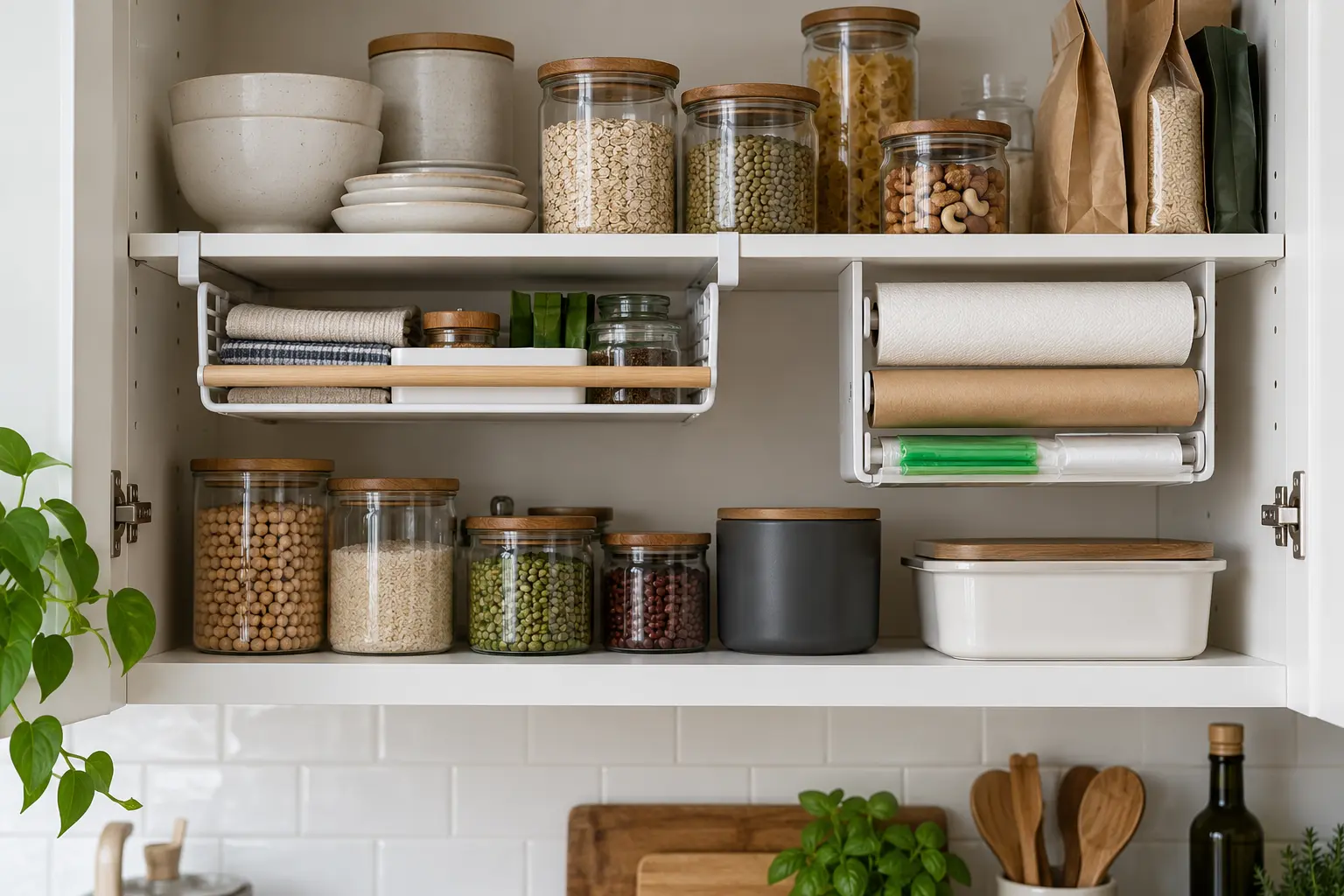
Under-shelf storage converts unused vertical space into a small, reachable zone. The tradeoff is that every inch added below the shelf is taken from the items underneath. A drawer is flexible for packets and small loose pieces; a dedicated holder keeps long rolls or bags together without consuming a drawer.
This guide compares the Joseph Joseph CupboardStore Under-Shelf Drawer with the CupboardStore under-shelf organizer for plastic wrap, film, foil and bags. We have not physically tested either product. Product facts come from the linked listing and manufacturer information; the measuring method is Small Space Project's editorial guidance.
Map the usable cabinet, not the empty cabinet
Measure the clear width between hinges, shelf supports and the cabinet sides. Then measure the shelf thickness and the vertical distance from the shelf underside to the tallest item below. Repeat the height measurement near the front, where a drawer or roll must move past the face frame and door hardware.
Next, load the cabinet as it is normally used. A slim organizer can fit an empty cabinet yet block the lid of a storage container, the neck of a bottle or the hand path used to lift a jar. Reserve a little working space rather than treating a dimension match as proof of comfort.
Drawer or dedicated holder?
Joseph Joseph CupboardStore Under-Shelf Drawer
Sliding and tilting drawer · tool-free adhesive installation · selected standard gray variant
Check the under-shelf drawer on Amazon · paid link ↗Joseph Joseph CupboardStore Film, Foil & Bag Organizer
Dedicated open holder · tool-free adhesive installation · selected standard gray variant
Check the wrap and bag organizer on Amazon · paid link ↗These are affiliate links. Availability, price, seller and the selected style can change on Amazon; confirm the exact variant and dimensions shown on the product page before ordering.
When the drawer format earns its space
The manufacturer lists the under-shelf drawer at 9¼ inches wide, 9 inches deep and 4 inches high. It is intended for units wider than 9¼ inches and shelves no thicker than ¾ inch. The installation uses shelf-edge hooks plus adhesive tape beneath the shelf, followed by a 24-hour wait before use.
That footprint is useful for stock cubes, packets, bags and other small items that disappear behind larger containers. The drawer also tilts at full extension, so test the space in front of it as well as the resting depth. Keep the load light and follow the installation sequence exactly; adhesive performance depends on a clean, compatible surface.
When a dedicated holder is better
The selected Amazon listing is designed to keep plastic wrap, film, foil and bags beneath a shelf. Its open format makes sense when long rolls are the repeated problem and you want to remove one without opening a drawer.
Confirm the exact selected size on Amazon. Joseph Joseph sells related regular and large formats, so do not transfer dimensions between variants. Measure the longest box or roll you actually use, then check that its end will not strike a hinge or cabinet wall during removal.
Make a five-minute paper test
- Mark the organizer's full width and depth on paper or thin cardboard.
- Tape the template beneath the intended shelf without loading it.
- Add the listed drop height with folded paper or an empty box.
- Open the door fully and rehearse sliding the drawer or removing a roll.
- Reach for the tallest item below. If your hand has to twist around the template, revise the layout.
The template cannot validate adhesive strength, but it can reveal a blocked hinge, a face-frame collision or a shelf that becomes awkward after the organizer is installed.
Before buying
- Measure the clear cabinet width, shelf depth and shelf thickness.
- Check the full drop below the shelf against the stored items.
- Use a drawer for small loose categories and a holder for long rolls.
- Confirm the shelf material is suitable for the specified adhesive.
- Follow the cleaning, pressing and curing instructions.
- Recheck the exact Amazon variant before checkout.
Sources and product reference
Product information checked September 24, 2026. This is a research-based planning guide, not a hands-on review. We make no current price, stock, durability, adhesive-performance or universal-fit claim.
- Joseph Joseph: CupboardStore Under-Shelf Drawer specifications and installation
- Joseph Joseph: related Film, Foil & Bag Organizer formats and installation
- Amazon affiliate link: CupboardStore Under-Shelf Drawer
- Amazon affiliate link: CupboardStore Film, Foil & Bag Organizer
The Amazon links on this page are affiliate links. We may earn a commission from qualifying purchases at no additional cost to you.