Measure the gap and the way out.
Use the lowest clearance across the entire route. Then check the opening, usable depth and floor space needed to pull the storage completely out.
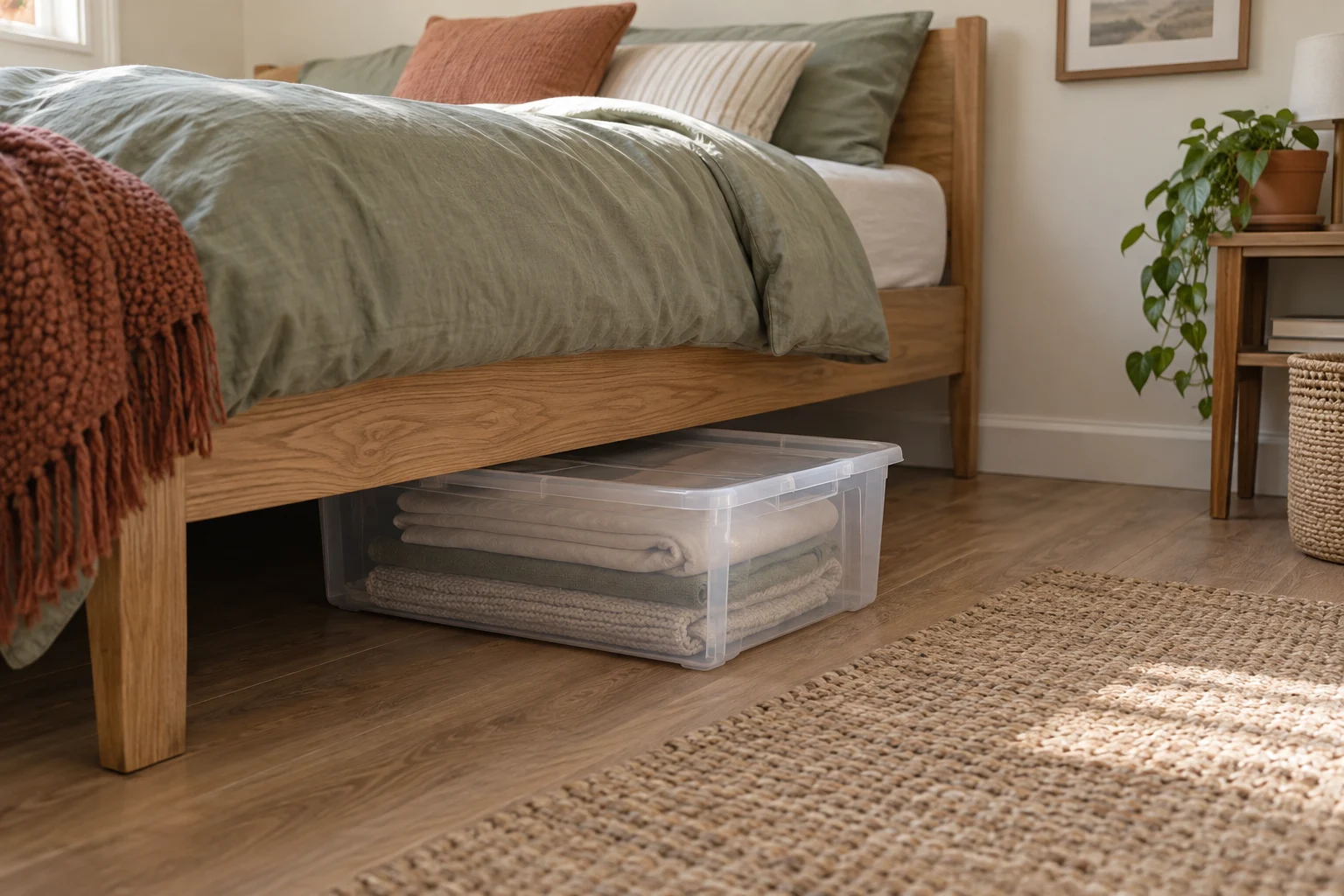
The space beneath a bed looks like one wide empty rectangle. In practice, it is divided by the frame, legs, center supports, nearby furniture and the patch of floor where a container must come out. A storage box can be shorter than the bed and still be awkward to use.
Measure the complete route before choosing a bin or drawer. This guide uses the IRIS USA 22 Qt Underbed Stackable Sliding Drawer as one current format example. We have not physically tested it. Product facts come from the manufacturer; the measuring method and layout checks are Small Space Project's editorial guidance.
Start with the lowest point
Measure from the floor to the lowest part a container must pass beneath. Check the side rail, footboard, brackets, center supports and any fabric hanging below the frame. Repeat the measurement in several places instead of assuming the gap is level.
Record the smallest usable height. A container whose listed height exactly matches that number leaves no practical allowance for an uneven floor, a flexible lid, your grip or a rug edge. We do not prescribe a universal extra clearance because the bed, floor and container differ. Test the intended route with a cardboard shape before ordering.
Also check whether the dimensions on a listing are external. IRIS says its published product measurements are exterior dimensions and include the lid where applicable. Storage capacity does not tell you the height, width or depth that must fit beneath the bed. IRIS measurement guidance
Measure the pocket, opening and pull-out path
Think of the under-bed area as separate pockets between the legs and supports. For each useful pocket, write down:
- Opening width: the narrowest space between legs or other obstructions along the entry route.
- Usable depth: how far the container can travel before meeting a wall, center support or another stored item.
- Clear height: the lowest floor-to-frame measurement across the entire route.
- Pull-out floor space: the clear distance beside the bed needed to bring the container fully out.
That last measurement is easy to miss. A deep container beside a wall, dresser or narrow walkway may fit under the bed yet stop before its lid or drawer can be opened. Include the normal position of a rug and anything kept beside the bed.
What the IRIS 22 Qt sliding drawer requires
IRIS lists its Underbed Storage Stackable Sliding Drawer as a two-pack, product 500347. Each unit is 23.69 inches long, 17.81 inches wide and 6 inches high. We use the manufacturer's dimensions; one Amazon feature bullet differs slightly by listing the length as 23.75 inches. The manufacturer describes a clear-view drawer with a molded handle and a lid with grooves that allow units to stack. IRIS product specifications
For under-bed use, compare all three external dimensions with one of your measured pockets. The six-inch height is only one part of the fit. The 17.81-inch width must pass the opening, and the 23.69-inch length needs room beneath the bed and beside it when you pull the drawer out.
A drawer format can provide access without lifting off a separate lid, but the drawer still needs a clear path to open. Place a paper or cardboard footprint beside the bed and mark the full depth. Check where your knees, chair, wall, nightstand or rug would be during an ordinary retrieval.
Choose the contents before the container
Under-bed space often becomes a holding area for things that have no assigned home. Decide what belongs there before counting boxes. Seasonal linens, occasional clothing or shoes have different shapes and access routines.
IRIS gives example capacities based on its roll-fold method, including ranges for T-shirts, jeans and blankets. Treat those as manufacturer examples, not a promise for every fabric or folding style. Bulky contents can change how easily a drawer closes even when the stated quart capacity sounds sufficient.
List the items and group them by how often you use them. Put frequently retrieved items in the easiest pocket. A hard-to-reach center section is better suited to something genuinely occasional. If you need an item every morning, a container that requires moving furniture is not a useful solution.
Stack only where the height exists
The manufacturer describes the units as stackable and modular, with lid grooves designed to lock one unit on another. Stacking may be useful in a closet or elsewhere, but two six-inch-high units will not become under-bed storage beneath a typical six-to-eleven-inch gap. Measure the assembled arrangement in the location where you plan to stack it.
Do not infer shelf or bed load capacity from the container's stacking feature. The product page does not provide a universal loaded-weight limit for the layout in your home. Keep the bed's structure, floor and your ability to move the filled drawer in mind.
Check the floor and your grip
The manufacturer's page describes a smooth-glide drawer, but it does not establish how the complete unit will move across every floor or rug. Check your own surface. A raised rug edge, floor transition or uneven board can interrupt the route.
Rehearse the movement with an empty cardboard template or a similarly sized item. Can you reach the handle area without putting your hand beneath the bed frame? Can you pull straight out? Is there somewhere to stand while opening the drawer? These are editorial handling checks, not manufacturer performance claims.
A five-minute fit check
- Measure the lowest point beneath the frame in several places.
- Map the clear pockets between legs and center supports.
- Compare all external container dimensions, not capacity alone.
- Reserve floor space for complete removal or drawer opening.
- Test the route with the rug and nearby furniture in their normal positions.
- Choose the contents and access frequency before choosing the quantity.
Buy only the number of units that correspond to measured pockets and real contents. A two-pack is useful only when both units have an accessible job.
Sources and product reference
Manufacturer information checked September 7, 2026. This is a research-based planning guide, not a hands-on review. We make no current price, stock, durability, floor compatibility, moisture protection, pest protection or load-capacity claim.
- IRIS USA: Underbed Storage Stackable Sliding Drawer 22 Qt 2 Pack, product 500347
- IRIS USA: how product dimensions are measured
- Amazon reference: selected two-pack, B0DY3553SM
The Amazon link is an ordinary product reference. This pilot contains no affiliate tags. Recheck the selected variant and current specifications before ordering.